


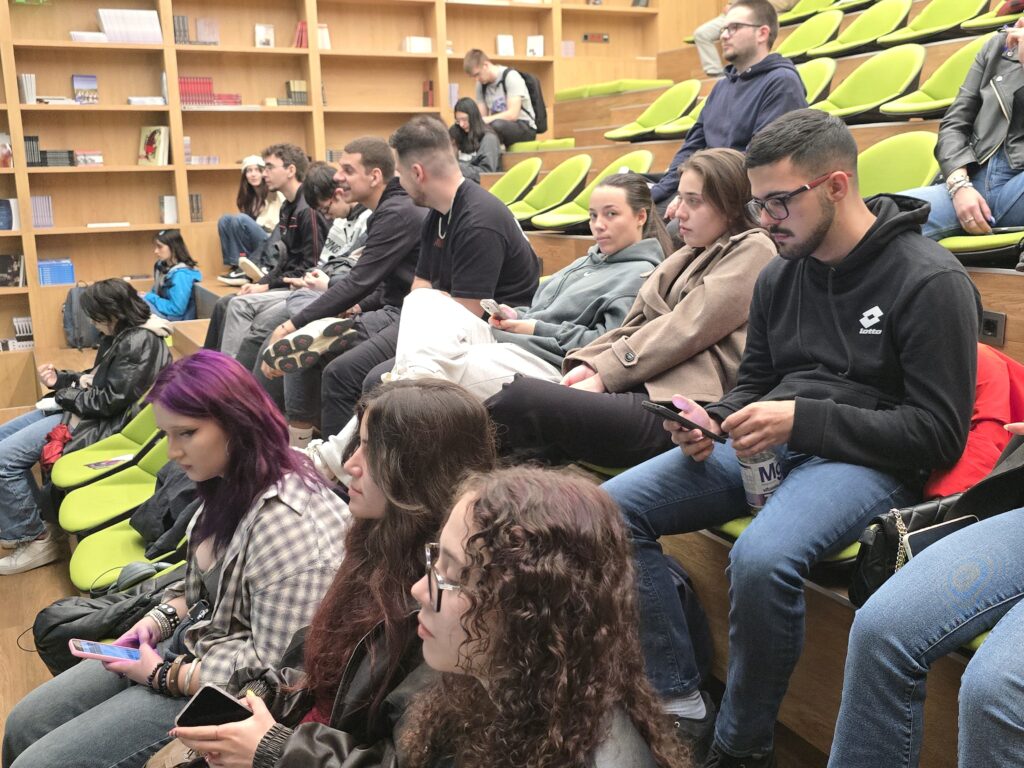
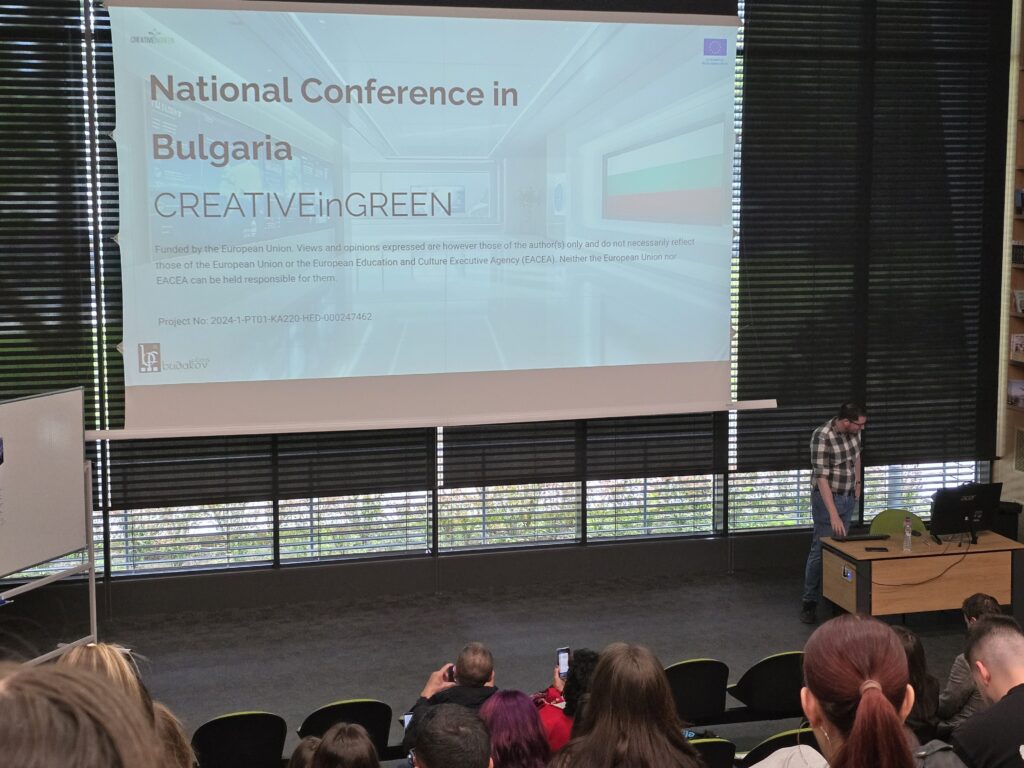
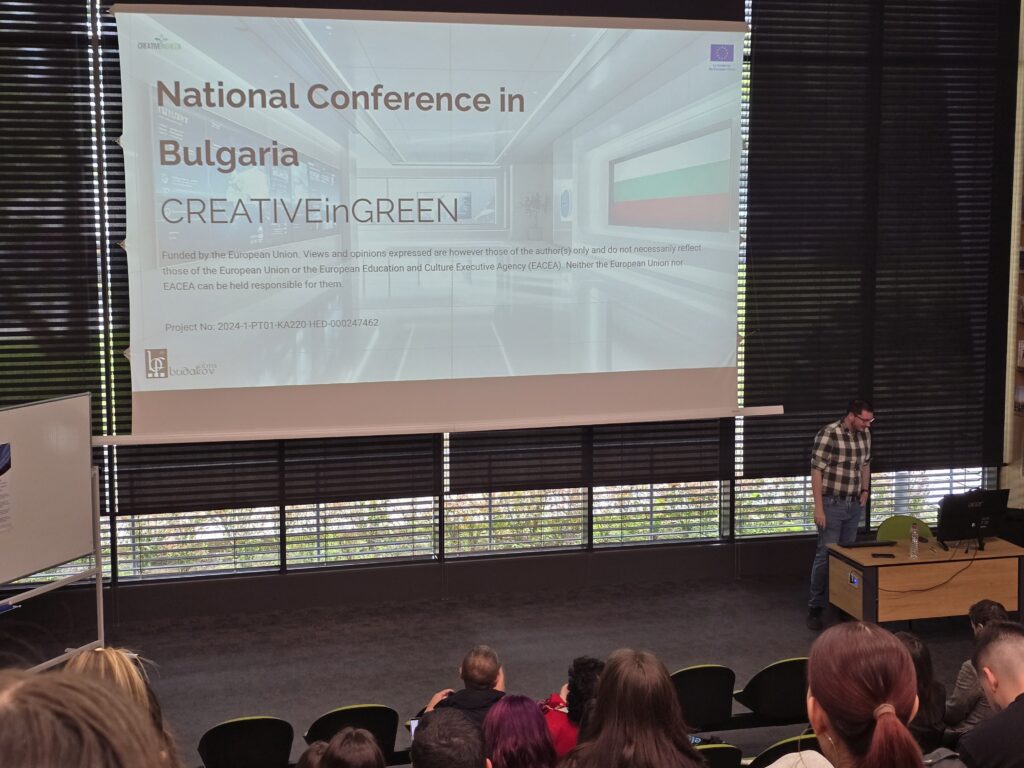
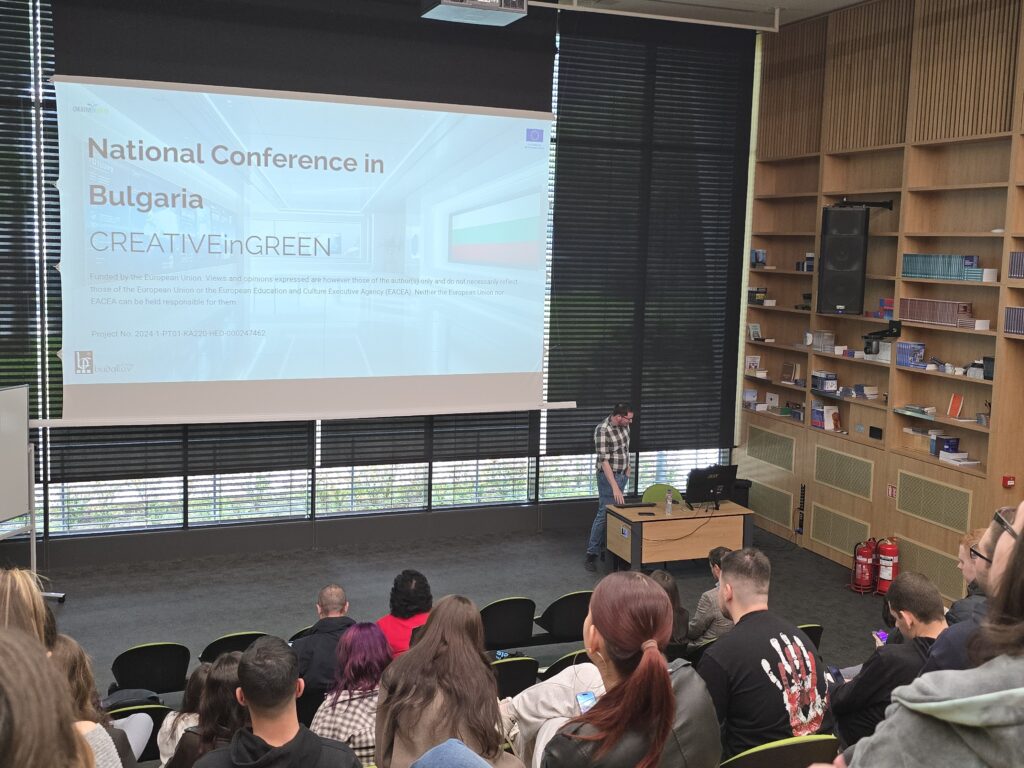
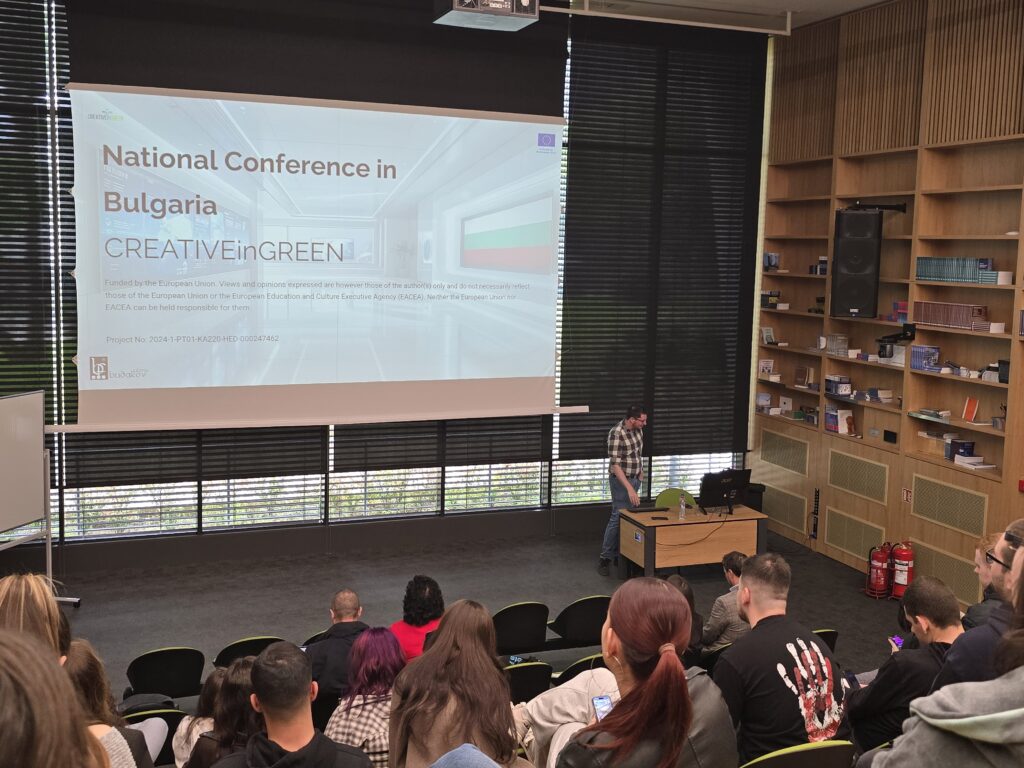
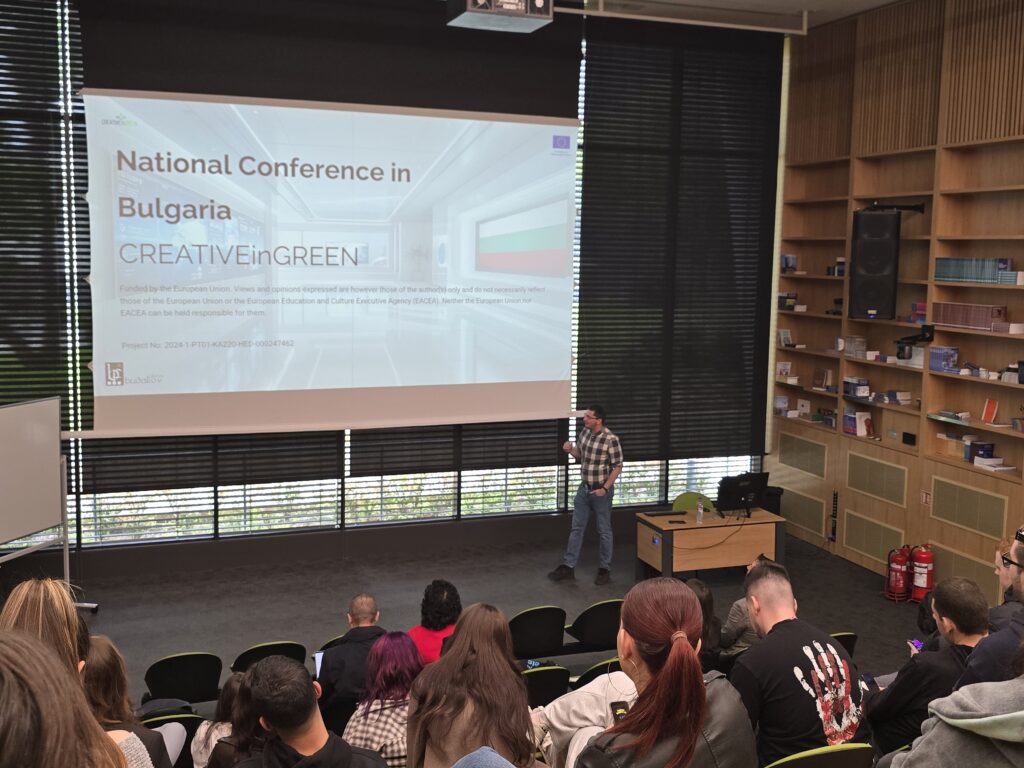
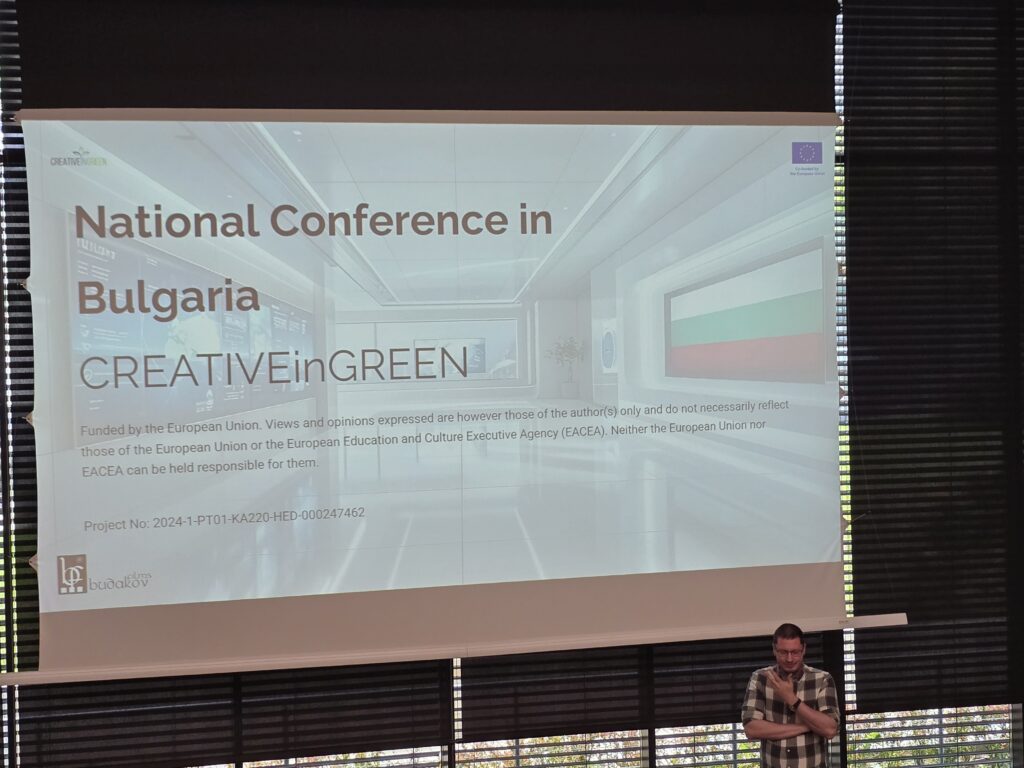
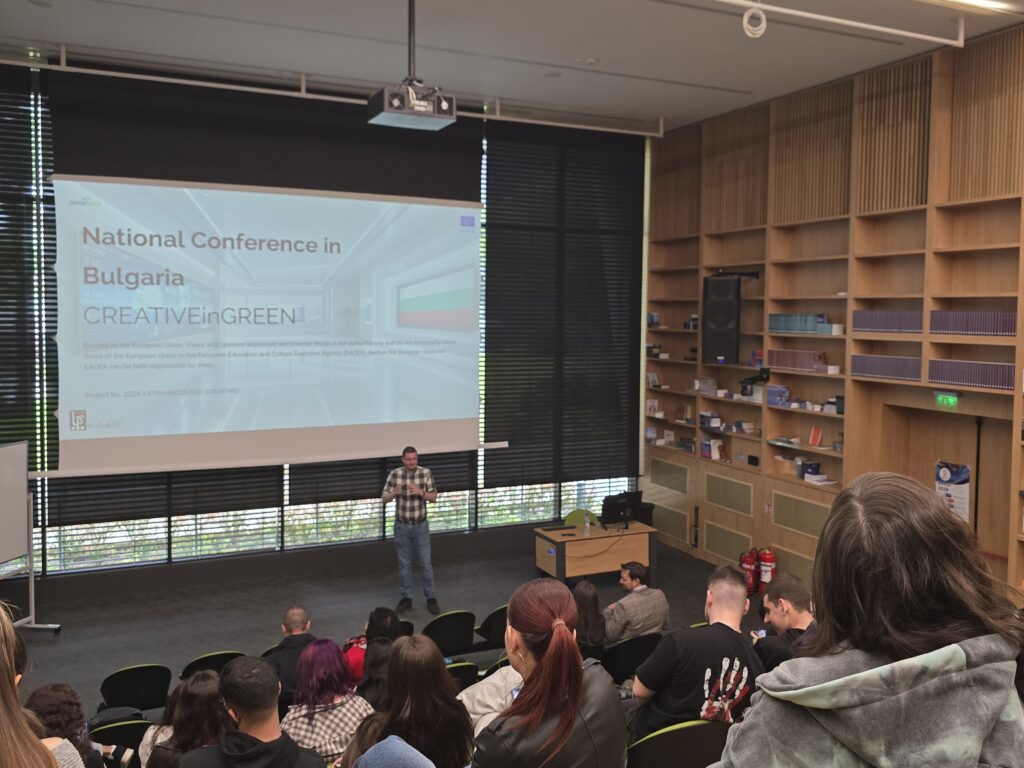
On 1 September 2026, Budakov Films organised the Bulgarian National Conference of the Erasmus+ KA220 project CREATIVEinGREEN, hosted by New Bulgarian University in Sofia. The event brought together 51 participants from higher education, the creative sector and related professional fields to discuss how artificial intelligence, sustainability and responsible digital design are transforming creative education and professional practice.
Under the theme “Sustainable Creativity, AI & the Green Transformation”, the conference served as an important national dissemination and impact event for CREATIVEinGREEN. Its central objective was not only to present project results, but to connect them with educators, researchers, creative professionals and other stakeholders who can further use, adapt and multiply the project’s approaches.
Turning Erasmus+ cooperation into national impact
A key ambition of Erasmus+ KA220 Cooperation Partnerships is to ensure that project results move beyond the consortium and generate wider educational, organisational and professional value. The Sofia conference directly supported this objective. With 51 participants attending in person, the event created a strong opportunity to increase awareness of CREATIVEinGREEN, demonstrate its practical outputs and encourage their future use within higher education and the creative industries. By hosting the conference at New Bulgarian University, Budakov Films also strengthened the connection between European cooperation, academic education and real-world creative practice.
Sustainable creativity in the age of AI
The conference opened with contributions from Assoc. Prof. Ilija Kozuharov, Ph.D., Dean of the Undergraduate Faculty at New Bulgarian University, and Prof. Dr. Petyo Budakov. The opening positioned CREATIVEinGREEN within one of the most important challenges facing creative education today: how to benefit from rapid technological development while maintaining human creativity, ethical responsibility and environmental awareness.
The first keynote and panel discussions explored the green transformation of the creative industries through AI and digital innovation. Topics included sustainable digital ecosystems, ethical AI, the future of creative education and the growing responsibility of designers and educators when integrating new technologies into their work. A central message emerged clearly: AI should strengthen human creativity rather than replace human judgement. Its value lies in helping creative professionals work more efficiently, test ideas more precisely and make better-informed decisions, while people remain responsible for purpose, quality and ethical evaluation.
Making CREATIVEinGREEN results visible and usable
One of the most important parts of the conference was the presentation of the concrete outputs developed through CREATIVEinGREEN.
Participants were introduced to the project’s:
- educational methodology and training framework;
- digital learning resources and toolkit;
- sustainable UI/UX principles;
- AI-supported creative workflows;
- pilot activities and learner-engagement approaches.
The significance of this session was its focus on practical use. Rather than discussing sustainability and digital transformation only at a conceptual level, CREATIVEinGREEN provides educational methods and resources that can be transferred into teaching, training and professional creative environments. This represents an important impact dimension of the project: transforming European cooperation into resources that can continue to generate value beyond the individual project activities.
Sustainable UI/UX as practical green transformation
A dedicated session on Sustainable UI/UX for the Creative Sector explored how sustainability can be embedded directly into digital design practice. The panel addressed energy-efficient digital design, accessible and inclusive interfaces, ethical AI-generated content and eco-conscious approaches to web and application development. The session was delivered by Dr. Yordan Karapenchev and Keti Tserovska, M.A.
This practical perspective demonstrated that sustainability is not only a strategic concept. It can influence everyday design choices: how interfaces are structured, how efficiently digital products operate, how accessible they are and how responsibly AI-generated content is used. The connection between green thinking, accessibility and responsible technology is therefore an important part of the CREATIVEinGREEN approach.
Strengthening higher education through European cooperation
Another central panel focused on Higher Education, Innovation & Erasmus+ Impact, with contributions from Assoc. Prof. Ilija Kozuharov, Ph.D. and Prof. Dr. Petyo Budakov. The discussion addressed international collaboration, digital transformation, sustainability, employability and the future skills required in the creative industries. The session highlighted one of the strongest benefits of Erasmus+ cooperation: the possibility to bring together complementary expertise from different countries and institutions and translate it into approaches that can be used in national and local contexts. For CREATIVEinGREEN, this means that the project’s value is not limited to the development of outputs. Its longer-term impact depends on whether educators, institutions and creative professionals can adopt, adapt and further disseminatethese results.
From dissemination to engagement
The conference therefore went beyond traditional presentations. An Interactive Showcase & Demonstration Session allowed participants to engage with project outputs, AI-assisted creative tools and learning materials. This was followed by an Open Discussion and Audience Q&A, creating space for professional exchange, feedback and reflection. This interaction is particularly important for Erasmus+ impact. Effective dissemination is not simply about reaching an audience. It is about creating conditions in which stakeholders can understand a project result, evaluate its relevance and consider how it could be applied in their own work. The 51 participants therefore represented not only event attendance, but also a group of potential users, multipliers and future collaborators.
A concrete contribution to CREATIVEinGREEN impact
The National Conference strengthened CREATIVEinGREEN in several important ways. It increased the visibility of the project in Bulgaria, transferred project knowledge beyond the partnership, connected the developed resources with academic and professional stakeholders, and created opportunities for further use and multiplication. It also reinforced the project’s longer-term sustainability by building connections between higher education, creative practice and European cooperation. For Budakov Films, the conference represented an important milestone in its role as a bridge between digital expertise, creative innovation and education. It demonstrated how Erasmus+ cooperation can produce impact not only through project outputs, but through the communities that engage with, apply and continue developing them. The Sofia conference confirmed a central principle of CREATIVEinGREEN:
The future of creativity should be not only more digital, but also more sustainable, responsible, inclusive and human-centred.
Funded by the European Union. Views and opinions expressed are however those of the author(s) only and do not necessarily reflect those of the European Union or the European Education and Culture Executive Agency (EACEA). Neither the European Union nor EACEA can be held responsible for them.
Project No: 2024-1-PT01-KA220-HED-000247462